Showing posts with label energy. Show all posts

Wednesday, February 15, 2017

Green dreamers are weaving baskets in the dark

Thursday, April 2, 2015

Why does Green peace embellish with nonsense?

Cetacean Strandings – a plea for honesty

Although I have previously written an article entitled “Do seismic surveys cause whales to strand?”, the recent passionate and vitriolic claims by eNGOs that strandings have been caused by seismic surveys, makes this topic worth re-visiting.  I make no apology for drawing the inspiration for my title from the publication by Bradshaw et al (2006) entitled “Mass Cetacean Strandings – a Plea for Empiricism”.  In that publication, Bradshaw et al stated “More specifically, the stranding-prone regions of the world such as southern Australia cannot be used to support the noise-pollution hypothesis because military and other sources of sonar noise pollution are relatively uncommon there”. Clearly, this statement would also apply to New Zealand, given the frequency of strandings there.
This statement was based on an empirical study by Evans et al (2005) entitled “Periodic variability in cetacean strandings: links to large-scale climate events” utilising data spanning 1920-2002 and 639 stranding events many of which occurred BEFORE marine seismic surveys were even invented and off coasts where few, if any, seismic surveys were carried out.
Why therefore do organisations such as OIL free SEAS_Kangaroo Island (OFSKI), Huffington Post writer Dr Reese Halter and Greenpeace NZ in conjunction with Oil Free Otago, continue to ignore scientists and the available observational data, such as that shown in the following photograph?
Humpback whale and seismic array
Humpback whale and operational seismic array
I would not presume to guess what their agenda is but here are a few examples of the way these organisations are misleading a caring and giving community with misinformation, which is plainly at odds with the available scientific and observational data.
1. On their Facebook page, along with lots of other very inaccurate propaganda, OFSKI claims that the sperm whale strandings on the East Coast of the Yorke Peninsula at Ardrossan were caused by seismic surveys approximately 700km away  with two peninsulas in the way. This is inconceivable given:
1a. Sperm whales vocalise at similar sound levels to seismic pulses – 236dB at 1m. Thus, what they hear themselves, or in their pod, from their own vocalisations, would be far louder than they would hear at even 100m from a seismic source. Note that if large whales were any closer that about 100m there would be a greater risk of collision than deafness, even though smaller more mobile whales (eg pilot whales) and dolphins are often seen riding the bow wave during seismic operations. It is inconceivable that any reasonable person could claim they are harmed by received sounds that are lower than those they emit themselves. Why does OFKSI and others insist on claiming such impacts?
1b. As a result of their loud vocalisations, it is not surprising to see many instances of sperm whales continuing to behave normally (dive, feed and rest) in fairly close proximity to operating seismic vessels in Australian waters and other areas around the world. For example, in a 2003 JNCC report entitled “The effects of seismic activity on marine mammals in UK waters, 1998-2000”, Stone concluded “Sperm whales showed no observable effects from these data (although this does not mean that there was no disturbance, as there may have been effects that were not able to be examined using these data).” If there were effects that could have led to strandings, as claimed by OFSKI, surely they would have been observable!
1c. Finally, sperm whale strandings in the presence of NO seismic surveys are not at all unusual (as mentioned in the above introduction). Why does OFSKI ignore such events? One of the most famous historical sperm whale stranding cases occurred on the Dutch coast in 1601 (yes, 1601 – long before seismic surveys were invented) and a very long way from sperm whale preferred habitat (a bit like Ardrossan?). This stranding is immortalised in an etching by Dutch artist Jan Saenredam. Thus, for OFSKI to claim that seismic surveys caused the Ardrossan mass stranding is a clear case of the observable data being ignored.
2. In an article in The Huffington Post entitled “Big Oil destroys the Great Australian Bight, Dr Reese Halter appears to come to the support of OFSKI but is clearly incorrect with the following assertions:
2a. Firstly, he claims “Big Oil Destroys the Great Australian Bight”. How come over 150,000km of seismic traverse have been acquired and 12 wells have been drilled in the area since the 1970’s and there have been negligible impacts from this activity? This does not sound like “destroying” to any reasonable person;
2b. Secondly, Dr Halter makes much of majestic blue whales being in danger from seismic surveys but, despite very close monitoring over more than a decade during seismic surveys conducted along the southern margins of Australia, it is obvious that they are not in the dire danger that he and others claim.  If Dr Halter were correct the impacts would have been obvious.  In addition, some of these monitoring reports are on the public record, so Dr Halter is clearly ignoring and distorting the facts.
2c. Thirdly, on the topic of distorting the facts, his claim that the melon-headed whale stranding in Madagascar in 2008 was caused by a seismic survey is totally false. In an IWC report on the incident, the Independent Scientific Review Panel (ISRP) concluded that they “systematically excluded or deemed highly unlikely nearly all potential reasons for the animals leaving their typical pelagic habitat and entering the Loza Lagoon (an extremely atypical area for this species). This included the use of seismic airguns in an offshore seismic survey several days after the whales were already in the lagoon system, which was originally speculated to have played some role but in the view of the ISRP clearly did not.”  Dr Halter has ignored at least two very important pieces of information – the seismic survey commenced several days AFTER the whales were already in the lagoon system AND the panel concluded that the seismic survey CLEARLY DID NOT cause the stranding.
3. Finally, we have Greenpeace NZ and its supporters such as Rosemary Penwarden of Oil free Otago.  The constant “noise” from this group is typified by an extremely misleading opinion piece in the Otago Daily Times on Friday 23 January entitled “Oil search puts dolphins at risk”.  There is very little, if any, valid evidence in the emotive but inaccurate claims by Ms Penwarden (and Greenpeace). For example:
3a. Ms Penwarden “links seismic testing for oil and gas with serious harm to whales and dolphins”. How can this be so if no documented cases of harm to cetaceans exist in over 40 years of seismic surveying (note the correct term “surveying”) using compressed air as the seismic source?
3b. Her description of seismic acquisition is so unrepresentative, using terms such as “detonators” and “blasting,” that it is surely meant to mislead a caring and giving community. “Velcro” has done a good job of presenting a factual description of seismic surveying in an online comment rebutting her article so I will not repeat what he/she says.  In addition, I’d like to counter Ms Penwarden’s statement that seismic arrays “reach about 260 decibels (dB) on a logarithmic scale on which it is known that anything above 170 dB disturbs marine organisms.” as being clearly incorrect.  Firstly, she has used a theoretical value (of 260dB) for the loudness of a seismic array. This would only be achieved if all the 20-30 elements (compressed air cylinders, commonly called “airguns”) in the array occupied the same location. This is clearly impossible!  The actual decibel level within 1m of any part of the array would be between 220 and 240dB, depending on the type of array.  Secondly, given sperm whales and bottlenose dolphins vocalise at 236dB and 225dB respectively (a lot more than 170dB), how can Ms Penwarden claim they would be disturbed, letalone “seriously harmed” as mentioned elsewhere in her opinion piece? After all, these cetaceans (or others in their pod) would receive vocalised sounds at close to their emitted levels whereas any received levels from the seismic array would be significantly lower than their own vocalisations.
3c. She perpetuates the inaccurate claim that the mass stranding of the melon headed whales in Madagascar was caused by a seismic survey. As mentioned above, the ISRP concluded the seismic survey “CLEARLY DID NOT” cause the stranding.
3d. Finally, she and Greenpeace claim that the unfortunate stranding of 3 Gray’s beaked whales on Whatipu Beach near Auckland last week was caused by a seismic survey, which I understand was 200km away. Given that strandings in NZ are very common and there is NO correlation between stranding events and seismic surveys, why are they ignoring the readily observable facts? How do they explain strandings that occurred in the absence of seismic surveys, either before seismic surveys were invented or in seasons when seismic surveys did not occur?  Given the frequency of strandings there will be coincidences but it is disingenuous to exploit these unfortunate incidents for their own ulterior motives.
In summary, these organisations surely have a responsibility to ensure that their claims are factually based and verifiable? “Truth in campaigning” should apply to lobby groups in the same way “truth in advertising/reporting” applies to businesses. Unfortunately, at best, these lobby groups are either displaying a high level of ignorance or, at worse, they have deliberately chosen not to display the same high level of honesty that they themselves demand from others.
The public deserves an open, transparent and honest debate on the unfortunate issue of cetacean strandings, but are misinformed by the likes of Greenpeace, Oil free Otago, OFSKI and Huffington Post (Dr Reese Halter).

Why do myths and misinformation drown information, facts and science?

Thursday, April 24, 2014

Price of green energy electricity

JÜRGEN KRÖNIG: ENERGY POLICY IN GERMANY – BIG PROBLEMS IN EUROPE’S POWERHOUSE

  •      http://www.thegwpf.org/jurgen-kronig-energy-policy-in-germany-big-problems-in-europes-powerhouse/   


  • I did read else where that Germans are paying 21 billion to receive green power that is only worth 2 billion. Begs the question just who is getting the rest of the money  in the video     
  • This hilarious video from a German national TV broadcast instantly disproves both:   http://www.breitbart.com/Breitbart-London/2014/04/23/Germany-discovers-sense-of-humour-loses-faith-in-green-energy

  • Date: 27/03/14
  • Jürgen Krönig, Policy Network

The coalition agreement between the German Social Democrats (SPD) and the Christian Democrats (CDU) has seen SPD leader Sigmar Gabriel become Minister for Economy and Energy in the Merkel cabinet. In a country with spiralling energy costs, he faces a daunting challenge to balance industrial competitiveness, social justice, green goals and energy security.

 
[...] Sigmar Gabriel, the SPD leader in charge of the Economy and Energy portfolio, is without doubt the most important minister in the cabinet of Angela Merkel but he is facing the most difficult task too. His job is to secure the competitiveness of Germany and its industries and he has to reform the German energy revolution, the “Energiewende”, which cannot be done without upsetting what the scientist James Lovelock in his book “The vanishing face of Gaia – a final warning” called the “green – industrial complex” that has established itself over the last twenty or so years and is determined to defend its vested interests, not least the enormous subsidies for wind turbines. Lovelock predicted then that “Europe’s massive use of wind for baseload electricity will be remembered as one of the great industrial follies of the twenty first century”.
Energiewende is committed to Germany’s energy transition to 100% renewables.Furthermore, Sigmar Gabriel will have to find a way to explain how the architects of the Energiewende came to ignore its flawed design based on miscalculations, lack of realism and wishful thinking. This uncomfortable task might be slightly easier because the Energiewende has many political parents, Greens, Social Democrats and Christian Democrats.
One especially disastrous element of the Energiewende, the rushed nuclear exit after Fukushima, was furthermore the responsibility of Merkel’s coalition with the Liberals.Business as usual is no longer an option. Without drastic changes the Energiewende will be even more threatening for Germany’s industrial base. German exports would have been €15bn higher last year if its industry had not paid a premium for electricity compared with international competitors, according to a recent analysis by the Energy Consultancy IHS.Germany’s manufacturing suffered already €52bn in net export losses for the six-year period from 2008 to 2013. The figure was calculated by linking changes in the net volume of German manufacturing exports to changes in energy costs, using an economic model that accounted for other variables such as exchange rates. Almost 60 per cent of the total loss (or €30bn) came in energy-intensive industries: paper, chemicals and pharmaceuticals, non-metallic mineral products and basic metals.
Smaller companies were disproportionately affected. Unlike heavy energy users such as BASF and Thyssen/Krupp, small companies are not eligible for exemptions from the energy bill surcharges that cover the costs of the move to clean energy. Even more worrying for Germany is a clear trend for investment to go abroad. IHS found that direct investment abroad has accelerated at the expense of domestic investment and the cost of energy was the most important driver of this shift. [...]
The utopian dream of an economy powered by renewables is more and more turning into a nightmare. In his recently published book “Klare Worte”, which means “blunt words”, ex-Chancellor Gerhard Schröder, under whom the “green energy revolution” started, is now calling for a revision of this policy; he warns of more damaging and unachievable targets for renewable energy and for CO2 reduction by the EU Commission and advocates a longer life for Germany’s remaining nuclear power stations that according to the official time table will have to shut down in 2022, thus increasing the fear of blackouts in Germany.
But the present coalition government, despite its intention to lower the burden for consumers and industries, is still determined to double the amount of renewables till 2030. So far it does not show any willingness to consider prolonging the life of the remaining nuclear reactors, despite now facing the Ukrainian crisis that should have alerted Berlin and other European capitals to the risk of diminished energy security and growing dependency on Putin’s Russia. [...]
Germany is not alone
Germany is not alone in Europe. The UK and other EU countries are facing similar problems in regards to the price of energy and the competitiveness of industries. But for Germany it is more difficult to turn around and admit mistakes. So much money has been spent, so much prestige and pride is at stake, and, in contrast to the more pragmatic British and the less easily frightened French, green convictions are much more deeply embedded in institutions, in culture, in the media and in politics – and Germany is a country with a strong, long established tradition of anti-modernism, nature worship and suspicion of technological and scientific progress.
During the heyday of climate fears in the last decade, centre-left politicians in Britain and Germany were united in the belief that climate change would be the new mass mobilising topic that would help save their parties. A more likely outcome is that this strategy will neither save the centre-left nor will it help to prevent climate change. The fate of the SPD may serve as an interesting lesson for other centre left parties. It is telling that according to the latest survey only 24% of Germans feel confident about their countries energy policy while 73 percent are dissatisfied and are ill at ease. This may be a warning that Sigmar Gabriel should heed. It is unlikely that most of those 73% demand even more wind turbines that blight so many landscapes of their country already without delivering the life blood on which an industrial nation depends.


Monday, March 17, 2014

Modern Environmental Doomsayers

Environmental Doomsayers Have Been Wrong Many Times Before.
“At the first Earth Day celebration, in 1969, environmentalist Nigel Calder warned, “The threat of a new ice age must now stand alongside nuclear war as a likely source of wholesale death and misery for mankind.” C.C. Wallen of the World Meteorological Organization said, “The cooling since 1940 has been large enough and consistent enough that it will not soon be reversed.” In 1968, Professor Paul Ehrlich, Vice President Gore’s hero and mentor, predicted there would be a major food shortage in the U.S. and “in the 1970s … hundreds of millions of people are going to starve to death.” Ehrlich forecasted that 65 million Americans would die of starvation between 1980 and 1989, and by 1999 the U.S. population would have declined to 22.6 million. Ehrlich’s predictions about England were gloomier: “If I were a gambler, I would take even money that England will not exist in the year 2000.”
In 1972, a report was written for the Club of Rome warning the world would run out of gold by 1981, mercury and silver by 1985, tin by 1987 and petroleum, copper, lead and natural gas by 1992. Gordon Taylor, in his 1970 book “The Doomsday Book,” said Americans were using 50 percent of the world’s resources and “by 2000 they [Americans] will, if permitted, be using all of them.” In 1975, the Environmental Fund took out full-page ads warning, “The World as we know it will likely be ruined by the year 2000.”
Harvard University biologist George Wald in 1970 warned, “… civilization will end within 15 or 30 years unless immediate action is taken against problems facing mankind.” That was the same year that Sen. Gaylord Nelson warned, in Look Magazine, that by 1995 “… somewhere between 75 and 85 percent of all the species of living animals will be extinct.”"

Monday, January 20, 2014

How do you evaluate wind energy?

A Problem With Wind Power 
[www.aweo.org]   [click here for printer-friendly PDF]by Eric Rosenbloom 
http://www.aweo.org/problemwithwind.html

Wind power promises a clean and free source of electricity that would reduce our dependence on imported fossil fuels and the output of greenhouse gases and other pollution. Many governments are therefore promoting the construction of vast wind "farms," encouraging private companies with generous subsidies and regulatory support, requiring utilities to buy from them, and setting up markets for the trade of "green credits" in addition to actual energy. The U.S. Department of Energy (DOE) aims to see 5% of our electricity produced by wind turbine in 2010. Energy companies are eagerly investing in wind power, finding the arrangement quite profitable.

A little research, however, reveals that wind power does not in fact live up to the claims made by its advocates [see part I], that its impact on the environment and people's lives is far from benign [see part II], and that with such a poor record and prospect the money spent on it could be much more effectively directed [see part III]. Links to aid the reader's own research are provided throughout this paper as well as at the end [see Links; off-site links will automatically open to a new window or tab]. Click here for an abbreviated version of this paper. Click here for an even briefer version (a handy model for letters). This paper is also available as a 7-page typeset PDF file (156 KB) -- click here.

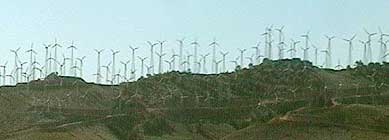
Tehachapi Pass, California

I.
Top • II • III • Links ]

In 1998, Norway commissioned a study of wind power in Denmark and concluded that it has "serious environmental effects, insufficient production, and high production costs." 

Denmark (population 5.3 million) has over 6,000 turbines that produced electricity equal to 19% of what the country used in 2002. Yet no conventional power plant has been shut down. Because of the intermittency and variability of the wind, conventional power plants must be kept running at full capacity to meet the actual demand for electricity. Most cannot simply be turned on and off as the wind dies and rises, and the quick ramping up and down of those that can be would actually increase their output of pollution and carbon dioxide (the primary "greenhouse" gas). So when the wind is blowing just right for the turbines, the power they generate is usually a surplus and sold to other countries at an extremely discounted price, or the turbines are simply shut off. 

A writer in The Utilities Journal (David J. White, "Danish Wind: Too Good To Be True?," July 2004) found that 84% of western Denmark's wind-generated electricity was exported (at a revenue loss) in 2003, i.e., Denmark's glut of wind towers provided only 3.3% of the nation's electricity. According to The Wall Street Journal Europe, the Copenhagen newspaper Politiken reported that wind actually met only 1.7% of Denmark's total demand in 1999. (Besides the amount exported, this low figure may also reflect the actual netcontribution. The large amount of electricity used by the turbines themselves is typically not accounted for in the usually cited output figures. Click here for information about electricity use in wind turbines.) In Weekendavisen (Nov. 4, 2005), Frede Vestergaard reported that Denmark as a whole exported 70.3% of its wind production in 2004. 

Denmark is just dependent enough on wind power that when the wind is not blowing right they must import electricity. In 2000 they imported more electricity than they exported. And added to the Danish electric bill are the subsidies that support the private companies building the wind towers. Danish electricity costs for the consumer are the highest in Europe. [Click here for a detailed and well referenced examination by Vic Mason.

The head of Xcel Energy in the U.S., Wayne Brunetti, has said, "We're a big supporter of wind, but at the time when customers have the greatest needs, it's typically not available." Throughout Europe, wind turbines produced on average less than 20% of their theoretical (or rated) capacity. Yet both the British and the American Wind Energy Associations (BWEA and AWEA) plan for 30%. The figure in Denmark was 16.8% in 2002 and 19% in 2003 (in February 2003, the output of the more than 6,000 turbines in Denmark was 0!). On-shore turbines in the U.K. produced at 24.1% of their capacity in 2003. The average in Germany for 1998-2003 was 14.7%. In the U.S., usable output (representing wind power's contribution to consumption, according to the Energy Information Agency) in 2002 was 12.7% of capacity (using the average between the AWEA's figures for installed capacity at the end of 2001 and 2002). In California, the average is 20%. The Searsburg plant in Vermont averages 21%, declining every year. This percentage is called the load factor orcapacity factor. The rated generating capacity only occurs during 100% ideal conditions, typically a sustained wind speed over 30 mph. As the wind slows, electricity output falls off exponentially. [Click here for more about the technicalities of wind as a power source, as well as energy consumption data. Click here for conversions between and explanations of energy units.

In high winds, ironically, the turbines must be stopped because they are easily damaged. Build-up of dead bugs has been shown to halve the maximum power generated by a wind turbine, reducing the average power generated by 25% and more. Build-up of salt on off-shore turbine blades similarly has been shown to reduce the power generated by 20%-30%. 

Eon Netz, the grid manager for about a third of Germany, discusses the technical problems of connecting large numbers of wind turbines [click here]: Electricity generation from wind fluctuates greatly, requiring additional reserves of "conventional" capacity to compensate; high-demand periods of cold and heat correspond to periods of low wind; only limited forecasting is possible for wind power; wind power needs a corresponding expansion of the high-voltage and extra-high-voltage grid infrastructure; and expansion of wind power makes the grid more unstable. [Click here for a good explanation of why wind-generated power can not usefully contribute to the grid and only causes greater problems, including the use of more "conventional" fuel.

Despite their being cited as the shining example of what can be accomplished with wind power, the Danish government has cancelled plans for three offshore wind farms planned for 2008 and has scheduled the withdrawal of subsidies from existing sites. Development of onshore wind plants in Denmark has effectively stopped. Because Danish companies dominate the wind industry, however, the government is under pressure to continue their support. Spain began withdrawing subsidies in 2002. Germany reduced the tax breaks to wind power, and domestic construction drastically slowed in 2004. Switzerland also is cutting subsidies as too expensive for the lack of significant benefit. The Netherlands decommissioned 90 turbines in 2004. Many Japanese utilities severely limit the amount of wind-generated power they buy, because of the instability they cause. For the same reason, Ireland in December 2003 halted all new wind-power connections to the national grid. In early 2005, they were considering ending state support. In 2005, Spanish utilities began refusing new wind power connections. In 2006, the Spanish government ended -- by emergency decree -- its subsidies and price supports for big wind. In 2004, Australia reduced the level of renewable energy that utilities are required to buy, dramatically slowing wind-project applications. On August 31, 2004, Bloomberg News reported that "the unstable flow of wind power in their networks" has forced German utilities to buy more expensive energy, requiring them to raise prices for the consumer. [Note, April 2012:  State support for industrial wind fluctuates, but the trend noted here has continued.] 

A German Energy Agency study released in February 2005 after some delay [click here] stated that increasing the amount of wind power would increase consumer costs 3.7 times more than otherwise and that the theoretical reduction of greenhouse gas emissions could be achieved much more cheaply by simply installing filters on existing fossil-fuel plants. A similar conclusion was made by the Irish grid manager in a study released in February 2004 [click here for 172-KB PDF]: "The cost of CO2 abatement arising from using large levels of wind energy penetration appears high relative to other alternatives." 

In Germany, utilities are forced to buy renewable energy at sometimes more than 10 times the cost of conventional power, in France 3 times. In the U.K., the Telegraph has reported that rather than providing cheaper energy, wind power costs the electric companies £50 per megawatt-hour, compared to £15 for conventional power. The wind industry is worried that the U.K., too, is starting to see that it is only subsidies and requirements on utilities to buy a certain amount of "green" power that prop up the wind towers and that it is a colossal waste of resources. The BWEA has even resorted to threatening prominent opponents as more projects are successfully blocked. Interestingly, long-term plans for energy use and emissions reduction by both the U.K. and the U.S. governments do not mention wind [click here for more about this (the article is in Spanish)]. Flemming Nissen, head of development at the Danish utility Elsam, told a meeting in Copenhagen, May 27, 2004, "Increased development of wind turbines does not reduce Danish CO2 emissions." 

Sunday, May 19, 2013

Corruption all over the USA


80% of Dept. of Energy loans went to companies owned by or connected to President Barack Obama's top campaign fundraisers

Can this be true?   Are the people in the USA this corrupt??? Sort of unbelievable ! ! Seem like every thing is corrupt and rubbish in the USA no matter which side of politics or business.
I had heard there are  mistakes and errors but  it  now seems that  it is just the way to do business.
The worst fear I have is that this is becoming not only nation wide but globally through Western Civilization and the contamination of the rotten apples has become a stinking stench and no intrinsic immunity or struggle against it

From Rags to Riches on You and Your Neighbor’s Tax Dollars

Author
By Jerry McConnell (Bio and Archives)  Thursday, May 16, 2013 
Comments | Print friendly | Subscribe | Email Us
The wheels of TRUE justice, not those of the Obama-Holder unJustice Department, are beginning to move, if ever so slightly; but moving they do appear to be.  With all the roadblocks the dastardly duo of Obama and Holder are placing in the path of progress, it’s a wonder that they are moving at all.
Those two conniving chameleons of corruptness and chicanery run the most illegitimate department of justice in the history of this one-time great country (BO - Before Obama).  In fact, to call it the Justice Department is the most improper and nonfactual title that could be bestowed on it.  Justice does not dwell within its parameters.
It is only fitting that officials holding office in the Congressional House of Representatives are finally stirring with comments that include the word ‘impeachment’.  It is about time and probably close to FIVE years late; but I shouldn’t be saying “late” as it is NEVER too late to bring daylight to the dark and mysterious corridors of that terribly mismanaged and mishandled Executive Department.  The apparent sins of the Treasury Department’s former tax-Cheat Secretary and currect Internal Revenue Service are childish when compared to the unJustice Department.
As columnist Wynton Hall has stated in a TownHall.com column “Report: Obama Spent $11.45 Million per ‘Green Job’ Created” online on May 08, 2013, that alone should have been enough ammunition for a legitimate Justice Department to get ITS wheels moving.  But alas, no such thing at the Obama-Holder vice den of obfuscation and corruption.
Truthfully, the entire Energy Department loan guarantee program has been a veritable money fountain of wealth to Obamanistas and the man himself.  As Wynton Hall says in his TownHall.com column: “In 2008, then-candidate Barack Obama promised to create 5 million “green jobs” if elected president. However, an analysis by the Institute for Energy Research (IER) finds that since 2009, the Department of Energy’s (DOE) $26 billion loan program created just 2,298 permanent jobs, at a cost of $11.45 million per job created.”
Any way you look at it two thousand, two hundred and ninety eight green jobs is one hell of a long way from FIVE MILLION green jobs; in other words, four million, nine hundred ninety seven thousand, seven hundred and two jobs short.  And Obama PROMISED to CREATE FIVE MILLION GREEN JOBS.  So far as I know the ONLY promise he has fulfilled during his whirlwind campaign prior to the election in November 2008 is that he would take care of his constituents and with 47 million of them on food stamps today he is keeping his word; AT OUR EXPENSE.
But let’s look at the BIG picture.  That number of less than 3,000 jobs at $11.45 million per job comes to a total of $26.3 BILLION.  Now you, Mr. and Mrs. Taxpayer are paying for those jobs.  That’s your $26 billion plus that you paid in taxes with the honest expectation that it would be spent honestly; but you were wrong; DEAD WRONG!  When this Administration smells or sees money they can figure a lot of ways to make it disappear.  And their always-ready-to-collude, party members, are fully complicit. 
As Mr. Hall states, “The losers are the American workers who would otherwise be gainfully employed but for the tremendous waste of taxpayer dollars on the administration’s obsession with ‘green energy,’” said Institute for Energy Research (IER) Policy Associate Alex Fitzsimmons. “As the economy continues to suffer and dollars for federal programs get harder to come by, it is getting increasingly difficult to defend a program that costs so much and produces so little.”
How many times has Obama passed billions of dollars on the “greening” of America only to see his campaign financiers take to create “green” corporations and then see them go belly up with all those tax dollars disappearing into thin air and Obama donors’ pockets. 
In his New York Times bestselling book “Throw Them All Out”, Government Accountability Institute President Peter Schweizer revealed that 80% of Department of Energy loans went to companies owned by or connected to President Barack Obama’s top campaign fundraisers. 
Read that again -  EIGHTY PERCENT OF THE DOE LOANS WENT TO OBAMA’S FUNDRAISERS.  Who knows how much was skimmed off in the process.
Don’t forget, Obama came into politics from a job as a street hustler for public service, traditionally exceptionally POORLY paid work; today he is worth multi-millions.  You do the math.  It’s your money he has now and he is the only one still smiling in America.
SUCKER!  How do you like that title, Mr. and Mrs. America?

Comments
Jerry McConnell is a longtime resident of planet earth with one half century on the seacoast of NH.  He is a community activist but promises not to run for President and he feeds ACORN’s to the squirrels.  He can be emailed atlethrneck@comcast.net with complaints or the editor atletters@canadafreepress.com with favorables.

Thursday, May 9, 2013

What would a true Queen Speech be like for the United Kingdom


Tomorrow will see the Queen's Speech. So here again is the Alternative Queen's Speech.

Screen shot 2013-05-07 at 07.50.52
By Paul Goodman
The Queen's Speech takes place tomorrow.  Harry Phibbs wrote about its contents over the weekend.  Last year, this site published an entire alternative Queen's Speech, and I thought it would be worth listing its measures in full:
  • British Bill of Rights Bill - "In all but the most exceptional circumstances, human rights cases brought in or against Britain should be decided in our Supreme Court, not Strasbourg."
  • Rail Improvements Bill - to plan for long-term investment in existing railways, rather than spend the same money on HS2.
  • Make Prison Work Bill - to ensure that foreign nationals serve sentences in their country of origin, and mentally ill criminals be sent to mental health professionals or social services.
  • Affordable Energy Bill - to cut electricity generation subsidies, facilitate the extraction of shale gas away from settlements, and promote more competition amongst suppliers.
  • Anti-Congestion Bill - to require local authorities as highways authorities to make reducing road congestion a requirement of their highways strategy
  • A Double EU Referendum Bill - to propose a Mandate Referendum for renegotiation followed by an In/Out Referendum, offering In on the renegotiated terms or Out.
  • Double Devolution Bill - to balance permitting the Scottish Parliament to set and collect most taxes with English votes for English laws at Westminster.
  • Finance Bill - to reduce the top rate of tax to 40%, take more people out of the 40% rate, and reduce Capital Gains Tax to 20%.
  • Trade Union Members' Bill - to make strike action legal only if 50% of a union's members take part in a ballot, and give union members more discretion over political levy donations.
  • Lords Reform Bill - to reform the Upper House after change has been considered by a Royal Commission.
A few of these ideas have been taken up by the Government.  For example, there seems to be overlap between its Queen's Speech proposals and the Fairness to UK Taxpayers' Bill - including the restrictions on state pensions for people based abroad floated today.
More cannot be enacted within the framework of the Coalition.  I have my doubts about one or two of the measures above - such as the double referendum bill, to which I'll return later this week - but many of the measures, such as the Electoral Integrity Bill, are badly needed.