http://www.dailymail.co.uk/news/article-5693381/Karl-Marx-titan-terror-communist-ideology-murdered-millions.html
Two hundred years ago today, the most controversial thinker of the modern age was born in the German city of Trier.
When, on May 5, 1818, Heinrich and Henriette Marx welcomed their little boy into the world, they could never have imagined the utopian hopes and blood-soaked horrors that would become associated with his name.
Two centuries later, the very words 'Karl Marx' still carry an unmistakable charge. No modern intellectual, no economist or philosopher can match the combustible power of the rabbi's grandson who fled into poverty-stricken exile in leafy North
London.
Most of the regimes based on Marx's ideas may have crumbled, yet his name remains synonymous with violent revolution, idealistic utopianism and the dictatorship of the proletariat.
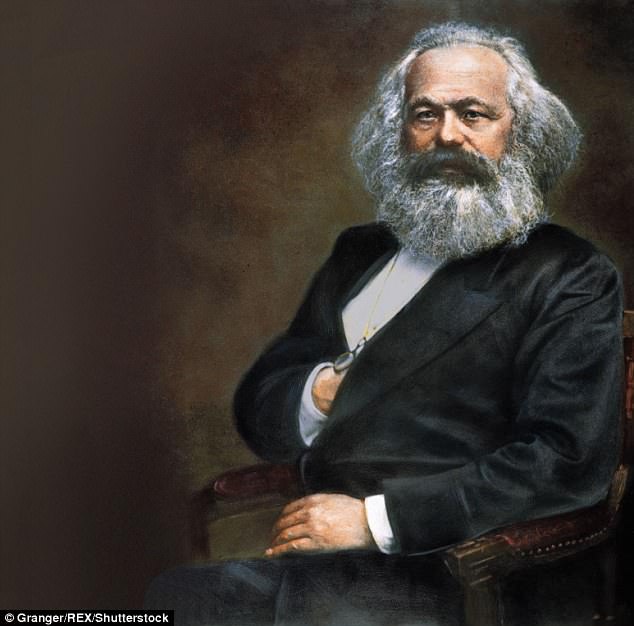
Karl Marx, founder of communism, was born in Germany 200 years ago today
It conjures up images of chanting crowds and glowering statues, collective farms and prison camps, tanks in Red Square and red flags over the Kremlin.
To his critics, Marx was a fanatic whose ideas inspired some of the cruellest regimes in history, from Stalin's Siberian gulags to the killing fields of Cambodia.
Yet, to his admirers — who include the current Labour leader Jeremy Corbyn, who recently called him a 'great economist', and the Shadow Chancellor, John McDonnell, who has named Das Kapital as his favourite book — he remains a visionary prophet whose ideas will, one day, lead mankind to a classless utopia.
His ideology was used as justification for some of history's worst mass murderers like Soviet leader Josef Stalin
If you doubt that Marx's legacy is still with us, just look at what happened yesterday in Trier, where the local authorities held a birthday party.
On hand to unveil a huge bronze statue, donated by the ruling Chinese Communists, was none other than the European Commission's president, Jean-Claude Juncker.
Mr Juncker got a lot of stick from critics, who said that he was insulting Marxism's victims.
The irony is that, since Mr Juncker is a bourgeois conservative politician, the very least he could expect in a Marxist regime would be a long stretch in a labour camp.
Yet, while I rarely have a kind word for Mr Juncker, I understand why he went.
More than thousands of other philosophers and economists put together, Marx still matters.
A colossal historical figure, he remains one of a handful of intellectuals who can claim to have genuinely shaped the way we think about the world.
His most famous books, The Communist Manifesto and Das Kapital, are still read in almost every country on Earth.
Video playing bottom right...
Loaded: 0%
Progress: 0%
1:10
ExpandClose
The Solovki prison camp (SLON), 1927-1928. Found in the collection of Memorial, historical and civil rights society
Construction of the Salekhard-Igarka Railway, so called 'Dead Road', Russia, 1950s. The project was built mostly by Gulag prisoners, thousands of whom died while working in extreme weather conditions of northern Siberia. The railway was never completed and was abandoned after Joseph Stalin's death
And although his ideas — the importance of class struggle, the urgency of revolution, the dream of a socialist society — remain hugely controversial, there is simply no escaping them. Indeed, you could even argue that, to some degree, we are all Marxists today.
That may sound odd, as most people in the UK are more likely to be small-c conservatives than card-carrying Lefties.
Indeed, Thursday's local election results strongly suggest that Corbynmania has peaked at last, which is good news for those of us who shudder at the thought of the hard-Left in power.
Even so, we are all familiar with the concepts of class conflict and class consciousness, the notion of history as a struggle between workers and elites and the idea that apparently trivial things such as films and fashion reflect the economic dynamics of the society that produced them.
We got all that from Marx. Of course, there are plenty of people who think that he was utterly wrong.
Even so, few would deny him a place, alongside other Victorian figures such as Charles Darwin and Sigmund Freud, as one of the genuinely titanic intellectual influences on the modern world.
What is often lost in all this, oddly, is the man himself.
Relocation of kulaks were to work in gulags (prison camps) 1930. Kulaks were Russian peasants, wealthy enough to own a farm and hire labour. Emerging after the emancipation of serfs in the 19th century the kulaks resisted Stalin's forced collectivization, but millions were arrested, exiled, or killed
Marx's acolytes revere him as a political thinker, a radical journalist who fled Germany after a failed revolution in 1848 and ended up as a refugee living in London, where he poured out great torrents of revolutionary rhetoric.
But, as Francis Wheen's brilliant biography points out, Marx was an unlikely candidate for a personality cult.
A hard-drinking, chain-smoking man, scruffy and shambolic, cadging money from his friends and cheating on his wife with his housekeeper, he might have been a great role for the Carry On veteran Sid James.
One detail that sticks in my mind is Marx's terrible trouble with genital boils.
Even as he was working on three volumes of Das Kapital, he was complaining to friends about the 'carbuncles on my posterior and near the penis, the final traces of which are now fading, but which made it extremely painful for me to adopt a sitting and hence a writing posture'.
In his darkest moments, the man who called for a world revolution spent his time attacking the pus-filled boils on his bottom with a cut-throat razor.
There must be a metaphor in there somewhere. Still, turning Marx into a comic figure does him little justice.
Mao Zedong murdered at least 40 million in the Chinese Cultural Revolution and caused many more to starve to death
As anyone who opens Das Kapital will know, his was an intellect of formidable power. Fearless, arrogant, ferociously clever, he never doubted that his work would survive.
There is, of course, another reason why we should take Marx seriously and you probably don't need me to spell it out.
When he died in penniless obscurity in 1883, just 11 people came to his funeral in Highgate Cemetery.
But within barely half-a-century, his reputation had been transformed.
The key factor, I think, was World War I, which shattered the prestige of the old order and opened up space for Marx's admirers to exploit — not least in Russia, where, almost unimaginably, power fell into the hands of the tiny, extremist Bolshevik Party.
In many ways, the story of the 20th century was that of Marxism in action.
From the Russian Revolution in 1917 to the collapse of the Soviet Union in 1991, one regime after another tried to put his revolutionary ideas into practice.
Execution after a 'people's tribunal' in the land reform movement in Communist China Huang, probably a landowner paid for his 'crime' by being shot, taken on January, 1953
Capitalism, Marx argued, was destined to collapse under the weight of its own contradictions.
Instead of bringing prosperity for all, economic growth would only widen the gap between a tiny, greedy elite and a huge, downtrodden and increasingly resentful majority.
Eventually, the working class, encouraged by a revolutionary vanguard, would seize the means of production in a violent uprising.
Then, under the dictatorship of the proletariat, human history would move into an entirely new age: no individual wealth, no class distinctions or economic ones. Mankind would have reached the promised land of communism.
So, how did Marx's vision work out? Well, the death toll speaks for itself. In the Soviet Union alone, his disciple Stalin killed perhaps 12 million people.
In China, Chairman Mao killed even more. Many experts think that, during his purges, collectivisations and massacres in the Fifties and Sixties, 45 million people lost their lives.
In the most chilling example of all, Cambodia between 1975 and 1979, Pol Pot's Khmer Rouge attempted to create a Marxist utopia overnight.
They forced the entire population of Cambodia's cities into the countryside, killed every teacher, merchant and member of the middle-class and even murdered people for wearing glasses.
In their pursuit of Marx's dream, the Khmer Rouge banned private property. Cambodians were limited to the ownership of a single spoon, but they had to eat communally.
Picking wild berries, for example, was seen as private enterprise, punishable by death.
Employees of the Shin Chiao Hotel in Beijing build in the hotel courtyard (background) in October 1958 a small and rudimentary smelting steel furnace during the period of the 'Great Leap Forward' (1958-1959), which was due to mobilize the Chinese population and to emphasize local authority and establish rural communes
In all, these peasant Marxists killed up to two million of their own people, about a quarter of the entire population, in barely four years. Never has there been a more horrifying example of what happens when utopian ideals become bloody reality.
I can already hear the cries of protest from Marx's followers. None of this, they say, was his fault. He had been dead for almost a century. Don't blame the man, blame his followers.
It is true that, as a man who spent his days holed up in the library, Marx was not himself a killer.
And as a perpetual dissenter who never shrank from speaking his mind, he would not have lasted long in the regimes he inspired.
Had he been around in Stalin's Moscow or Pol Pot's Cambodia, he would probably have ended up in a shallow grave with a bullet in the back of his head.
Even so, when I hear his defenders denying any link between Marx and his blood-soaked apostles, I wonder how supposedly clever people can be so stupid.
For all their cynicism and corruption, the men who ran the communist bloc never doubted that they were good Marxists.
The Soviet Union's founding father, Lenin, wrote several books about Marxist thought, which he described as 'the only correct revolutionary theory'.
Mao believed that Marx's ideas represented 'the good, the true and the beautiful'.
Chinese peasants on a communal farm in the 1950's during the 'Great Leap Forward'
Even the Khmer Rouge thought their new Cambodia — a classless society with no elites, no banks and no private property — was the fulfilment of Marx's vision.
The idea they were all guilty of some dreadful misunderstanding, and were not true Marxists at all, strikes me as ludicrous.
The best example is Stalin. As the U.S. historian Stephen Kotkin has shown, the Soviet dictator was not a monster who happened to be a Marxist. He was a monster because he was a Marxist.
As a young man, Stalin studied Marx's theories with obsessive dedication. Then, after winning power, he put them into practice.
Stalin did not kill millions of his own people because he was mad. He did it because he believed Marx's theories required it.
He thought their deaths were a price worth paying for the collectivisation of agriculture, the end of private farms and the coming of a socialist society.
Pol Pot systematically wiped out up to three million in Cambodia
The body of Pol Pot lies on a mattress in a small hut near the Thai-Cambodia border Thursday, April 16, 1998. Pot, according to Thai Military officials, died late Wednesday, April 15, 1998
Although Marx's acolytes will never accept it, Stalin was not perverting his hero's vision.
In fact, violence had formed part of Marx's worldview from the very beginning.
'There is only one way in which the murderous death agonies of the old society and the bloody birth throes of the new society can be shortened, simplified and concentrated,' wrote Marx in 1848, 'and that way is revolutionary terror'.
Here is Marx a year later, addressing his conservative adversaries: 'We have no compassion and we ask no compassion from you,' he writes. 'When our turn comes, we shall not make excuses for the terror.'
The truth is that Marx's vision was inherently violent. How could it be otherwise? How, without bloodshed, would you get your revolution? How would you abolish private property?
Here is a crucial distinction between Marxism — which is often called a 'political religion' — and genuine religions.
Christianity, for example, abjures violence and Christians are supposed to turn the other cheek.
But Marxism is violent by definition. If Marxists turned the other cheek, they would never get their revolution.
The other difference is that most religions venerate the individual.
Racks of human skulls & bones of slaughtered Cambodians, a grisly reminder of the atrocities perpertrated by Pot Pol, ldr. of the Cambodian Khmer Rouge
Kam Muth, a refugee from the Thai-Cambodian border is pictured placing human remains on a platform at the former Trapeang Sva village school. The school is suspected of being used as part of a complex of prisons and execution sites used by the Khmer Rouge during the Pol Pot regime in Cambodia
In Judaism and Christianity, the wellsprings of mainstream Western politics, individual life is sacred, because man is made in God's image.
But, for Marxists, the individual is irrelevant. Man is merely the servant of history. All that matters is the collective, the grand sweep.
And if that means some people — Russian landowners, Chinese merchants, Cambodian teachers, Cuban dissidents — end up in mass graves, prison camps or psychiatric hospitals, that is just their tough luck.
This sort of thinking strikes me as obscene.
Yet, thanks to the sheer force of Marx's intellect, it has attracted some very clever people.
The British historian Eric Hobsbawm, who died in 2012, was, by all accounts, a perfectly civilised man. But even after the truth about Stalin's purges and Mao's atrocities was known, he refused to leave the Communist Party.
Max's supporters say he can't be held responsible for the violence do in his name
When, years later, an interviewer asked Hobsbawm whether the deaths of '15, 20 million people' would have been worth it if they had brought the communist utopia a little closer, he did not hesitate.
'Yes,' he said.
What could possess an intelligent man to say something so monstrous?
There is, I am afraid, an obvious answer. Hobsbawm was a Marxist, pursuing to the bitter end the ruthless logic of his faith.
I understand why people still read Marx and why they take him seriously. What I will never understand, though, is why people put him on a pedestal, grovelling before his statue like worshippers in some weird cult.
How, for example, can Labour's John McDonnell seriously think that Marx, a man born in 1818, has the answers to the problems confronting Britain in 2018?
And how can people ignore the damning evidence of the crimes committed in his name?
On Marx's grave in Highgate, a shrine for his slavish admirers, are inscribed his words: 'The philosophers have only interpreted the world in various ways. The point, however, is to change it.'
Generations of youngsters have seen those words as a gloriously utopian call to arms.
(glory to the "collective" then of terror and death; death to the bourgeoisie, death to the intellectuals/thinker, death to the land owner, death to the dissident, death to the capitalist, death to the individual, who, and what ever it takes, death!)
Supporters of the Frontline Socialist Party display placards with the images of (L-R) Karl Marx, Friedrich Engels and Vladimir Lenin as they take part on a May Day rally in Colombo
A person dressed as Karl Marx takes part in a mass left-wing rally marking International Workers' Day in Moscow
Who, when they are young, does not dream of changing the world?
But, in their hubris, Marx's followers cast aside not only history and tradition, but tens of millions of lives.
In the name of progress, they slaughtered men, women and children like animals in an abattoir.
And in almost every corner of the Earth, mass graves testify to the diabolical power of Marx's vision.
His ideas belong where they began: behind the doors of the library, in the rarefied world of pure theory, but not in the real world, where people get hurt.
For if the past two centuries have taught us anything, it is surely this. There is nothing so dangerous as a man who wants to change the world.